
India–UK CETA - 2026
India–UK CETA: A Strategic Blueprint for Growth, Investment and Long-Term Economic Partnership
Restart Global Consulting's Perspective
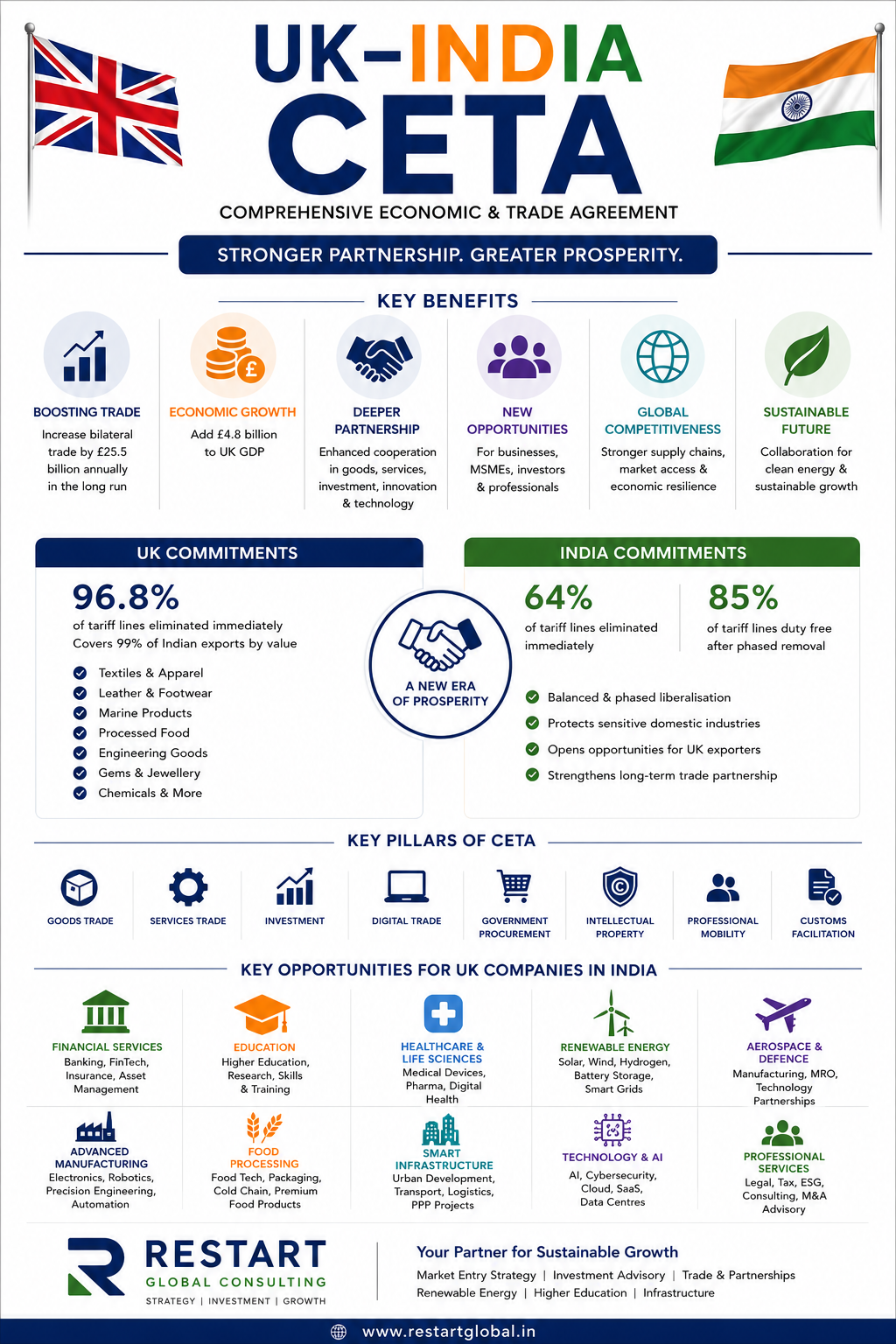
The recently concluded India–UK Comprehensive Economic and Trade Agreement (CETA) marks one of the most significant developments in UK–India economic relations in recent decades. More than a conventional trade agreement, CETA establishes a comprehensive framework designed to strengthen trade, services, investment, innovation, professional mobility, and long-term economic cooperation between two of the world's largest economies.
While much attention has focused on tariff reductions and export opportunities, the true long-term value of the agreement lies in its potential to accelerate deeper economic integration between the United Kingdom and India. Businesses that approach India solely as an export destination may realise short-term gains. However, organisations that establish local operations, build strategic partnerships, invest in talent, and participate in India's innovation ecosystem are likely to achieve far greater long-term success.
At Restart Global Consulting, we believe the India–UK CETA should be viewed as a catalyst for a new era of bilateral business collaboration—creating opportunities not only for trade expansion but also for investment, technology transfer, manufacturing growth, research partnerships, and sustainable economic development.
Why India Matters Now
India has emerged as one of the world's most attractive investment destinations. Supported by strong economic fundamentals, extensive digital transformation, infrastructure expansion, demographic advantages, and policy reforms, India is increasingly becoming a preferred destination for global businesses seeking long-term growth.
The India–UK CETA arrives at a pivotal moment. Bilateral trade between India and the UK has already reached approximately USD 56 billion, with both governments expressing an ambition to substantially increase this figure in the coming years.
Beyond trade, India offers several structural advantages:
One of the world's largest and fastest-growing consumer markets.
A highly skilled workforce across engineering, technology, finance, life sciences, and professional services.
Rapid expansion of digital infrastructure and technology adoption.
Growing manufacturing capabilities supported by government initiatives.
Increasing integration into global supply chains.
Strong entrepreneurial and innovation ecosystems.
These factors position India not merely as a production base but as a strategic growth market and innovation hub for international businesses.
From Trade Agreement to Strategic Opportunity
The India–UK CETA provides improved market access across goods and services while strengthening economic cooperation in multiple sectors. The agreement includes provisions relating to trade in goods, services, digital trade, financial services, innovation, intellectual property, mobility of professionals, government procurement, and other areas that support modern commercial activity.
For UK businesses, this creates an opportunity to rethink their India strategy.
The most successful organisations over the next decade are likely to be those that move beyond a traditional export-led model and adopt a more integrated approach built around:
Local presence
Strategic investment
Talent development
Innovation partnerships
Supply chain integration
Long-term market participation
Strategic Recommendations for UK Businesses
1. Enter the Market Early
Major economic agreements often create a window of competitive advantage for first movers.
Businesses that establish operations, partnerships, distribution networks, and brand recognition during the early stages of implementation are often better positioned to secure market share before competition intensifies.
Early engagement allows organisations to:
Build customer relationships
Understand local market dynamics
Establish trusted partner networks
Create sustainable competitive advantages
2. Build a Local Presence Rather Than Relying Solely on Exports
Exports remain important, but long-term success in India increasingly requires local engagement.
Depending on sector and business objectives, companies should evaluate:
Wholly owned subsidiaries
Joint ventures
Strategic alliances
Manufacturing facilities
Shared service centres
Regional headquarters
Research and development centres
A local presence often enhances customer engagement, improves responsiveness, reduces supply chain costs, and strengthens market understanding.
3. Position India as a Manufacturing and Export Platform
India is increasingly attracting global manufacturers seeking diversified and resilient supply chains.
Supported by initiatives such as Make in India and Production Linked Incentive (PLI) programmes, many international companies are evaluating India as a base for serving not only domestic demand but also regional and global markets.
For UK businesses, India can potentially serve as a strategic export platform for:
Asia-Pacific markets
Middle Eastern markets
African markets
Emerging high-growth economies
4. Develop Strong Local Partnerships
Market entry risks can be significantly reduced through collaboration with trusted local partners.
Successful businesses often establish relationships with:
Industry specialists
Distribution partners
Technology companies
Universities and research institutions
Industry associations
State governments
Professional advisory firms
Local knowledge frequently becomes a decisive factor in navigating regulatory environments, identifying opportunities, and accelerating growth.
5. Invest in India's Talent Advantage
India produces one of the world's largest pools of highly qualified professionals across technology, engineering, finance, healthcare, research, and business management.
Forward-looking organisations increasingly view India as a location for:
Global capability centres
Technology development
Engineering services
Research and innovation
Data analytics
Digital transformation programmes
Shared business services
Rather than viewing India solely through a labour-cost lens, companies should recognise the country's expanding role as a global knowledge and innovation hub.
6. Align Investments with National Growth Priorities
The strongest investment opportunities often emerge where business objectives align with long-term national development priorities.
Key sectors expected to attract substantial investment include:
Renewable Energy
Supporting India's clean energy transition and sustainability objectives.
Advanced Manufacturing
Including electronics, automotive, industrial equipment, and precision engineering.
Artificial Intelligence and Emerging Technologies
Driven by rapid digitalisation and technology adoption.
Financial Services and FinTech
Building on India's globally recognised digital payments ecosystem.
Healthcare and Life Sciences
Expanding healthcare access, innovation, and medical infrastructure.
Smart Infrastructure
Including urban development, transport systems, and sustainable infrastructure.
Education and Skills Development
Addressing workforce transformation and future skills requirements.
Defence and Aerospace
Driven by increasing localisation and technology partnerships.
Food Processing and Agribusiness
Supporting food security, exports, and value-added manufacturing.
Logistics and Supply Chain Solutions
Critical to supporting industrial growth and trade expansion.
How Restart Global Consulting Supports UK Businesses
Successfully entering and scaling within India requires more than market opportunity—it requires effective execution.
Restart Global Consulting supports international organisations throughout their India market-entry and expansion journey through:
Market entry strategy and feasibility assessments
Investment advisory and localisation planning
Business partner identification and due diligence
Regulatory and compliance guidance
Site selection and state incentive evaluations
Supply chain localisation strategies
Government and institutional engagement
Leadership and specialist talent acquisition
Higher education and research collaborations
Renewable energy and infrastructure advisory
Cross-border investment facilitation
International business development support
Our objective is simple: to help organisations minimise risk, accelerate implementation, and build sustainable long-term operations in India.
Looking Beyond Trade: Building the Next Phase of UK–India Economic Cooperation
The India–UK CETA represents far more than a mechanism for reducing trade barriers. It establishes a foundation for stronger economic integration between two highly complementary economies with shared ambitions for innovation, growth, sustainability, and international competitiveness.
For UK businesses, India offers access to a rapidly expanding consumer market, world-class talent, growing manufacturing capabilities, and an increasingly sophisticated innovation ecosystem.
For Indian businesses, the agreement strengthens export competitiveness, encourages investment, enhances professional mobility, and supports India's continuing emergence as a major global economic power.
The organisations that derive the greatest value from this agreement will be those that embrace a long-term investment mindset. Strategic localisation, strong partnerships, capability building, and disciplined execution will be the defining characteristics of future success.
The opportunity created by the India–UK CETA is substantial. The challenge now is not whether businesses should engage—but how quickly and effectively they can position themselves to benefit from this new chapter in UK–India economic relations.
About Restart Global Consulting
Restart Global Consulting is an international business advisory firm specialising in market entry strategy, international trade, investment facilitation, renewable energy, higher education partnerships, and cross-border business development.
The firm works with businesses, investors, educational institutions, and government stakeholders to help organisations successfully establish, expand, and scale operations across India and international markets.
Website:www.restartglobal.in
Author: Restart Global Consulting
Date: July 2026
 12 Jul 2026
 14 Nov 2025
 05 Jul 2025
14 Nov 2025
05 Jul 2025
14 Nov 2025