International University Campuses in India
A New Era for International Higher Education in India
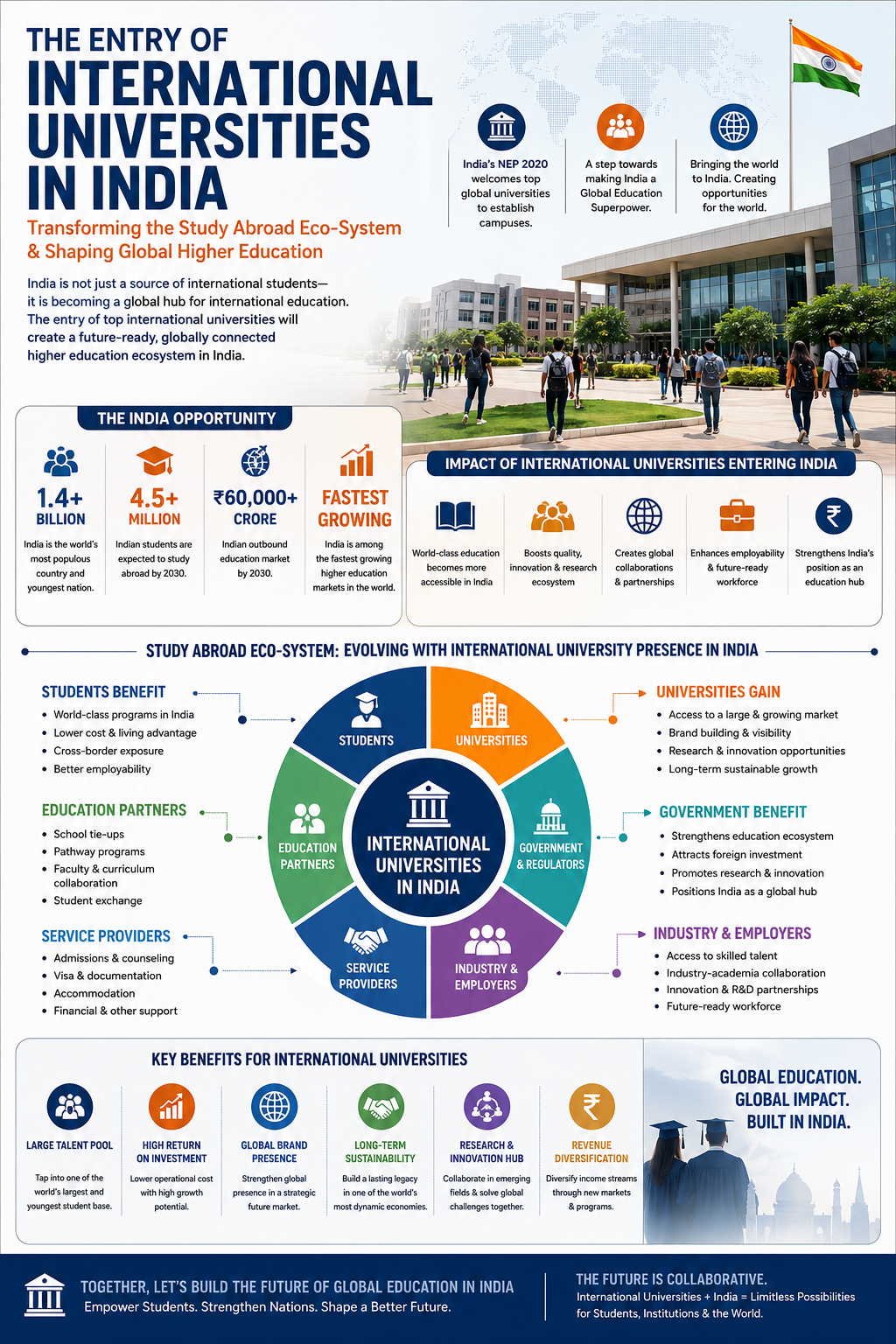
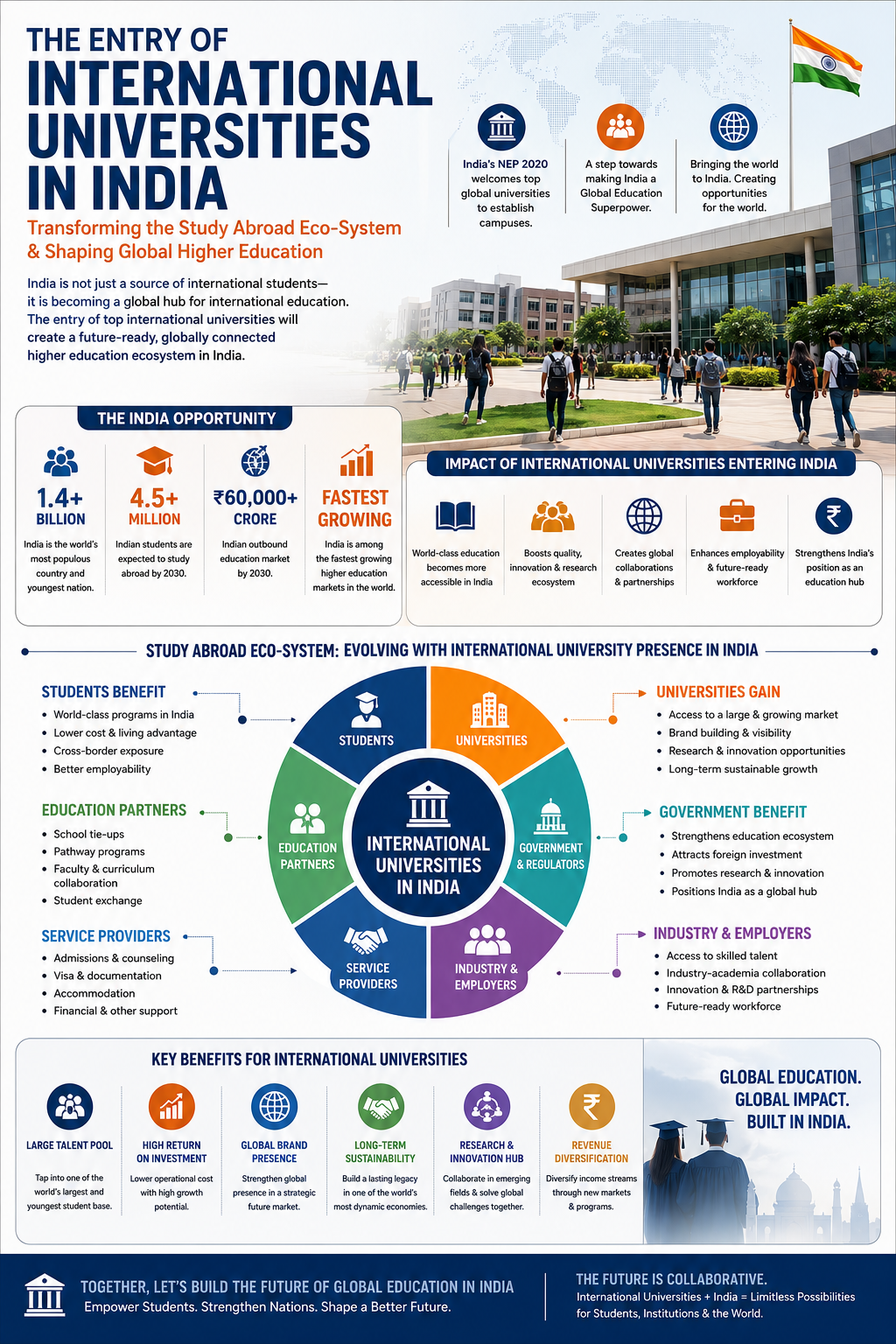
India’s higher education sector is undergoing one of its most significant transformations since liberalisation. Under the National Education Policy (NEP) 2020, the Government of India has encouraged leading global universities to establish campuses in the country. In June 2026, the University of Bristol, the University of York, and the University of New South Wales (UNSW) received approval to set up campuses in Mumbai and Bengaluru. These approvals follow earlier permissions granted to other international institutions, bringing the total number of foreign universities that are operational, approved, or in the process of establishing campuses in India to 17.
This development is more than the opening of a few new campuses. It signals a structural shift in the global higher education landscape, with important implications for international student mobility, universities worldwide, education consultants, and students themselves.
Foreign Universities Establishing or Approved for Campuses in India
The following international universities have been announced, approved, or associated with campus expansion plans in India:
· Deakin University
· University of Wollongong
· Queen's University Belfast
· Coventry University
· University of Surrey
· University of Bristol
· University of York
· Illinois Institute of Technology
· University of Aberdeen
· University of Western Australia
· University of New South Wales
· University of Liverpool
· Lancaster University
· La Trobe University
· University of Southampton
· Western Sydney University
· Victoria University
The Traditional Study Abroad Model is Being Disrupted
For decades, the study abroad industry has been built around a straightforward value proposition:
"Leave India to obtain international education."
That proposition is now evolving.
Students can increasingly access the following without leaving India:
International curricula
Foreign faculty
Global university brands
International degrees
Industry-focused programmes
This changes the decision-making landscape for students and families.
The arrival of globally recognised institutions such as UNSW, Bristol, and York gives Indian students a new option between domestic higher education and overseas study.
As a result, a third category is emerging:
Traditional Options
Study at an Indian university
Study abroad
New option:
Study at a foreign university campus in India.
This new category is likely to reshape how students compare cost, brand value, mobility, employability, and international exposure.
Will Indian Students Stop Going Abroad?
Not entirely.
However, student mobility patterns are likely to become more selective and differentiated.
According to government data, more than760,000 Indian students studied abroad in 2024, making India one of the world’s largest sources of international students. Indian students continue to seek opportunities in the US, UK, Canada, Australia, Germany, Ireland, Finland, Sweden, and other destinations.
The drivers behind outbound mobility remain strong:
International work experience
Immigration opportunities
Global networks
Exposure to new cultures
Access to specialized research facilities
International career pathways
A campus in Mumbai or Bengaluru cannot fully replicate the experience of living, studying, and working in London, Sydney, Helsinki, Stockholm, Munich, or New York.
International student mobility will therefore continue, but the profile of students choosing to go abroad is likely to change.
Impact on Different Study Destinations
UK and Australia
Some of the first destinations to feel competitive pressure may be the UK and Australia.
Many students who previously considered:
Lower-ranked UK universities
Regional Australian universities
may now conclude that studying at a branch campus of a prestigious university in India offers stronger value.
Families may increasingly ask:
“Why spend ₹50–80 lakh overseas when a respected UK or Australian university degree is available in India?”
This question is likely to become more common as local foreign campuses gain visibility and credibility.
As a result:
Mid-tier universities may face recruitment challenges.
Institutions heavily dependent on Indian students could see pressure on enrolments.
Universities competing mainly on brand recognition may struggle.
Finland
The impact on Finland is likely to be moderate, but still important.
Finnish universities compete through:
Innovation ecosystems
Research excellence
Sustainability leadership
Technology expertise
High-quality teaching
However, Finland’s global brand remains less prominent than that of the UK, US, or Australia.
The risk for Finnish universities is not necessarily that students will choose Bristol Mumbai over Aalto University or Tampere University directly.
The greater risk is that students who primarily want an international credential may no longer feel the need to leave India at all.
This could reduce demand among:
Price-sensitive students
Students uncertain about relocation
Students focused primarily on credentials
Germany
Germany is likely to remain comparatively resilient.
Its value proposition is unique:
Low tuition fees
Strong engineering reputation
Europe's largest economy
Manufacturing and industrial excellence
Extensive post-study opportunities
No branch campus in India can fully recreate Germany’s industrial ecosystem.
Students interested in automotive engineering, advanced manufacturing, robotics, and applied sciences will continue to view Germany as a destination, not merely as a degree provider.
Sweden and Other Nordic Countries
Sweden, Denmark, and Finland face a related challenge.
These destinations have traditionally sold:
Innovation
Sustainability
Entrepreneurship
Research
Quality of life
The challenge now is to communicate why students should experience these ecosystems in person, rather than simply earn an international qualification.
Impact on University Revenues
Indian students represent a critical revenue stream for many international universities.
In several major destination countries, Indian students have become the largest or second-largest international student group.
For example, Indian students represented approximately27% of all international students in the United States in 2024, with around 420,000 Indian students enrolled.
Many universities rely heavily on international tuition revenue.
If even 5–10% of prospective Indian students decide to remain in India and study at foreign campuses, the financial implications for some institutions could be substantial.
Universities may experience:
Reduced international tuition income
Increased competition for Indian applicants
Higher recruitment costs
Greater pressure to demonstrate ROI
This pressure will be particularly significant for:
Business schools
Computing programmes
Master's degrees
Universities dependent on international tuition
Impact on Students' Quality of Learning
The effect on educational quality is nuanced.
Potential Benefits
Students may benefit from access to:
International curriculum
Global academic standards
Lower living costs
Reduced visa risk
Proximity to family
Better affordability
This could democratise access to international education.
Students who previously could not afford overseas study may now be able to access global universities at a lower overall cost.
Potential Limitations
At the same time, students may miss out on several important dimensions of overseas education.
Cultural Immersion
Living abroad develops:
Adaptability
Independence
Intercultural communication
These capabilities are difficult to replicate fully within a domestic setting.
International Networking
One of the strongest benefits of studying abroad is the opportunity to build relationships with:
Global peers
International faculty
Employers
Alumni networks
These networks can have a long-term influence on career development.
International Career Exposure
Students studying abroad gain direct access to:
Internships
Graduate jobs
Professional networks
Foreign campuses in India cannot fully reproduce this advantage.
Impact on Education Consultants
The education consulting business model is also undergoing a major transition.
Historically, consultants generated revenue by:
Student recruitment
Visa assistance
Application processing
University partnerships
The new environment requires a different approach.
Students are increasingly asking:
"What is the best pathway for my career?"
rather than:
"Which country should I choose?"
Recent industry trends suggest that students are placing greater emphasis on career outcomes, employability, and return on investment than on university prestige alone.
This fundamentally changes the role of education consultants.
How Study Abroad Consultants Can Remain Relevant
1. Become Career Advisors
Consultants must move beyond admissions processing.
Students need guidance on:
Career pathways
Industry demand
Employability outcomes
Long-term mobility
The consultant of the future will need to act as a career strategist, not only an admissions intermediary.
2. Focus on Outcomes
Students increasingly evaluate:
Graduate employment
Salary potential
Post-study work rights
Career progression
Consultants should therefore shift from destination-based counselling to outcome-based counselling.
3. Promote Experiential Value
Foreign campuses can replicate degrees.
They cannot fully replicate:
International exposure
Cultural immersion
Global networking
International work experience
These experiential dimensions should become central to recruitment messaging.
4. Develop Hybrid Models
Future growth may come from:
1+1 programmes
2+2 pathways
Semester exchanges
Summer schools
Dual degrees
Such models can reduce costs while preserving meaningful international mobility.
How Universities in Finland and Other Destinations Can Stay Relevant
Shift from Selling Degrees to Selling Experiences
The degree itself is becoming less differentiated.
Universities must increasingly communicate the value of:
Ecosystems
Innovation clusters
Research opportunities
Industry partnerships
Career outcomes
Build Stronger Employer Connections
Universities should highlight:
Internship opportunities
Employer partnerships
Graduate employment statistics
Alumni success stories
Students are increasingly assessing return on investment before making education decisions.
Increase Presence in India
Universities that invest in:
Local representation
School engagement
Alumni networks
Industry collaborations
will be better positioned to maintain visibility, trust, and relevance.
Create Mobility Pathways
Rather than competing directly with foreign campuses in India, universities should develop pathways that complement them.
Examples include:
Transfer programmes
Articulation agreements
Dual degrees
Joint research initiatives
Conclusion
The arrival of foreign university campuses in India does not mark the end of study abroad.
It marks the beginning of a more competitive, sophisticated, and outcome-driven international education marketplace.
The institutions most at risk are not necessarily universities as a whole, but those that continue to rely on an outdated message:
“Go abroad because it is foreign.”
The winners will be those that can clearly demonstrate:
Career outcomes
Employability
Global exposure
Research opportunities
Industry integration
International mobility
India is evolving from being one of the world’s largest sources of international students into an important destination for international education in its own right. Universities and consultants that adapt to this reality will continue to thrive. Those that do not may become increasingly irrelevant in the decade ahead.
 14 Nov 2025
 05 Jul 2025
-
05 Jul 2025
14 Nov 2025